Why cloud FinOps matters in a large enterprise, and how it actually works
August 30, 2026 · 7 min read ·
TL;DR
Cloud made spending decisions distributed and continuous, but most companies still manage cost with a monthly invoice and a finance team that sees it last. FinOps closes that gap: a central platform that turns raw billing data into per-team numbers, and an operating model where the teams spending the money own those numbers. It only works if the underlying data is trustworthy.
I've spent about six years building the cloud cost platform used across every engineering organization at a large enterprise. In that time the thing I've had to explain most often isn't a technical detail — it's why this function needs to exist at all. Finance has managed budgets forever. Engineering has always cost money. Why is "FinOps" suddenly a team, a platform, and a line in the org chart?
The short answer is that cloud changed who makes spending decisions, and how often.
Cloud handed the budget to engineers
In a pre-cloud enterprise, spending money on infrastructure was an event. Someone requested capacity, someone approved a purchase order, hardware arrived, and the cost was fixed for years. Finance saw every one of those decisions before the money moved.
Cloud removed the event. Any engineer with credentials can now provision a database, spin up a fleet of GPU instances, or turn on a managed service that bills per request — in seconds, with no approval step. That's the entire value proposition of cloud, and it's genuinely good. But it means the company's infrastructure budget is now spent by hundreds of people making thousands of small, continuous decisions, most of which no one reviews.
At scale this adds up fast. On the estate I work with, we've surfaced more than $30M in savings opportunities over the years, with a comparable amount actually remediated. That money wasn't wasted by anyone acting carelessly. It accumulated from reasonable local decisions — an oversized instance here, a forgotten environment there, a commitment nobody renewed — that no single person was positioned to see.
The monthly invoice is not a control
Most companies' first instinct is to route cloud cost through the process they already have: the invoice arrives, finance reviews it, questions get asked. The problem is timing. A cloud bill lands weeks after the spending happened, aggregated to a level where the interesting detail is gone. By the time anyone asks "why did this go up," the team responsible has moved on to three other things, and the answer requires archaeology.
Consumption pricing breaks the feedback loop that budgets rely on. The decision and its cost are separated by a month, and the person who sees the cost is not the person who made the decision. You can't manage a continuous, distributed process with a slow, centralized report.
What FinOps actually is
FinOps is the practice of putting that feedback loop back. The FinOps Foundation frames it as three phases you cycle through continuously: inform, optimize, operate.
- Inform — get accurate, timely cost data to the people who can act on it, broken down the way they think about their work: by team, by service, by product, by customer.
- Optimize — find the specific, actionable reductions: rightsizing, eliminating waste, buying commitments where usage is stable, choosing cheaper architectures.
- Operate — build the habits and ownership that keep the first two from being a one-time cleanup: cost in sprint planning, alerts that reach the right team, targets that mean something.
The framing I find most useful: FinOps is not a cost-cutting team. It's an accountability loop. The goal isn't the lowest possible bill — it's that every team knows what it spends, sees it quickly, and owns the number. Sometimes the right outcome of that loop is spending more, deliberately, because the return is there.
How it works inside an enterprise
Concretely, a FinOps platform in a large company does a few things, roughly in order of how hard they are.
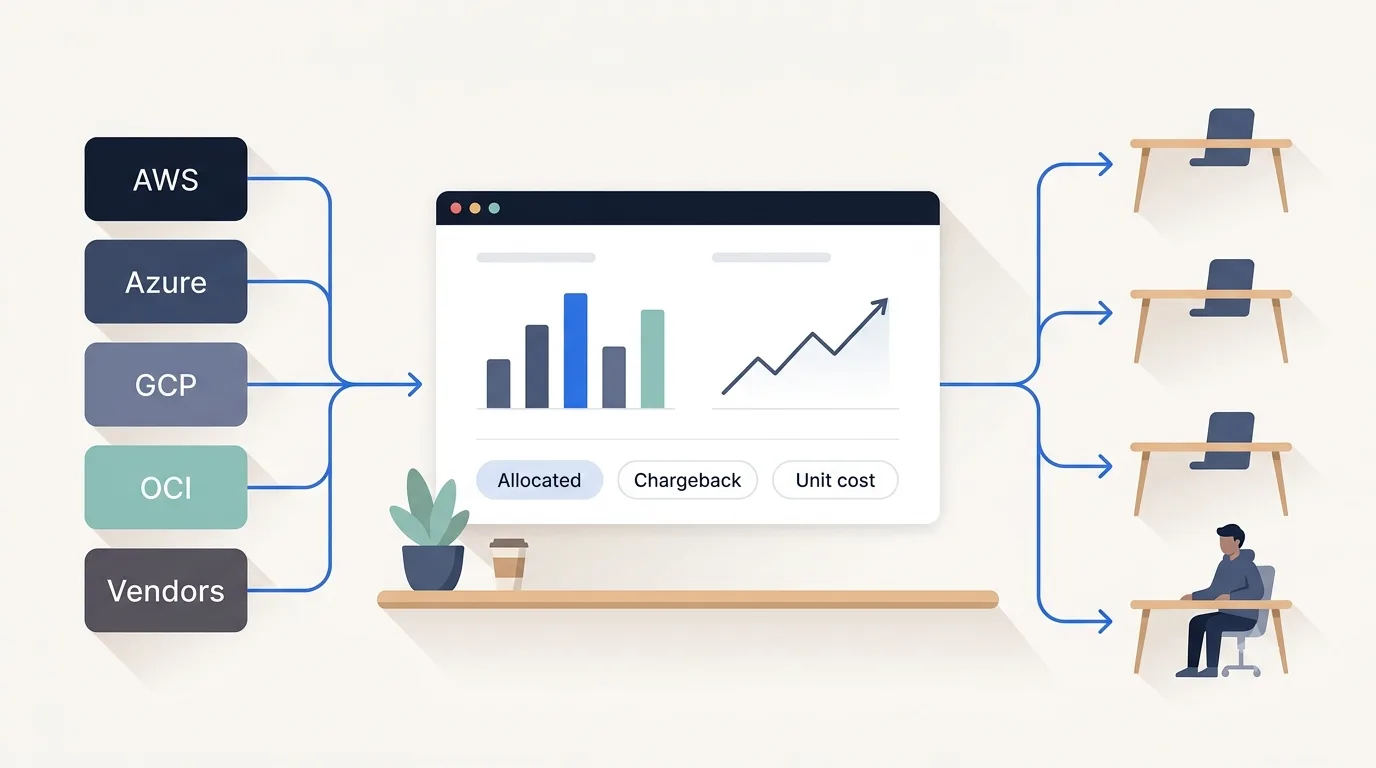
The foundational one is allocation. Raw billing data doesn't know about your org chart, so turning "this line item cost $4,000" into "this belongs to the payments team's fraud service" takes tagging discipline plus a mapping layer that handles everything untagged or shared. Get this wrong and nothing downstream is trusted.
On top of allocation sits the choice between showback and chargeback. Showback means every team can see its own costs; chargeback means those costs actually hit the team's budget. On our platform, chargeback and cost allocation run through more than 100 engineering teams, and the shift from one to the other is where behavior changes, because now the number has consequences.
Then there's commitment management — reserved instances, savings plans, committed-use discounts, all of which trade flexibility for a lower rate. Managing them well across a large, changing estate is centralized work, because no individual team has enough of the picture to make the call.
Alongside that runs continuous waste identification: idle resources, unattached storage, oversized instances, environments nobody turned off. The platform scans for these and routes each one to the owning team with enough context to act on it.
The most valuable piece, and the hardest, is unit economics — connecting cost to a business metric like cost per transaction, per active user, or per model inference. This is what lets leadership reason about whether spend is healthy, because a rising bill is fine if cost per customer is falling.
Underneath all of it is a normalization layer. We pull from four cloud providers plus third-party vendors like Datadog and Snowflake, each with its own billing format, and fold them into a single cost model so a team that runs in two clouds sees one coherent picture. AI spend has made this harder — a token-based vendor bill and a GPU-hour bill don't share a natural unit — but the principle is the same: normalize first, report second.
The org shape that makes it work
The pattern that works: a central platform team owns the data pipeline, the allocation logic, and the tooling. Distributed engineering teams own their own numbers and their own optimization decisions. The central team's product is trustworthy data and good defaults, not a mandate.
The failure mode I've watched play out elsewhere is a central FinOps team that owns the savings target instead of the data. When cost reduction is one team's KPI, every other team treats them as the cost police, engagement becomes adversarial, and the recommendations get ignored because they're seen as someone else's agenda. Ownership has to sit with the people who write the code, or it doesn't stick.
It starts with data quality
If I had to name the one thing that determines whether a FinOps effort succeeds, it's whether people trust the numbers. Nobody rightsizes an instance because a dashboard told them to if they've been burned once by a dashboard that was wrong. Every allocation error, every double-count, every "that's not our service" erodes the credibility of everything else the platform says.
So the unglamorous work — reconciling against the actual invoice, handling untagged spend honestly, being conservative about savings estimates — is the work. Get the data right and adoption follows almost on its own, because teams want to understand their costs. Get it wrong and no amount of process will save it.
That's why I think of cloud cost as an engineering data problem first and a finance problem second. The finance questions are real, but you can't answer them on a foundation people don't believe. If you want the shape of what that platform looks like in practice, I've written more about the pieces on the services page.
The takeaway
Treat cloud cost as an engineering data problem before you treat it as a savings target. The organizations that get value from FinOps are the ones whose teams trust the numbers enough to act on them without being told to.